
From Plantation to Pallet: How Vietnam's Board Supply Chain Works
A board that reaches a European warehouse has already travelled through a chain of decisions: where the mill sits, how the veneer is dried, how the panel is pressed, how it is packed and which documents travel with it. Dongstar Wood runs that chain from a single site in Yen Bai Province, northern Vietnam, established in 2009, with 48,000 m² of factory and a warehouse of more than 3,000 m².
Key takeaways
- The mill sits in Yen Bai Province, northern Vietnam, and was established in 2009.
- 48,000 m² of factory and more than 3,000 m² of warehouse hold 16+ automated production lines.
- Monthly supply capacity exceeds 100 × 40ft, and clients are served in over 170 countries and regions.
- Export packing is protective wrapping, steel strapping and wooden pallets, with custom packaging for large projects.
Where the mill sits
Location is the first link in the chain, and it is a choice. Yen Bai Province, northern Vietnam, places the mill between the plantation forests of the north and the port infrastructure that serves Europe and America. The client's own pages name the location as part of the company's identity, and for a buyer the location answers a question before it is asked: the panels are pressed where the timber is, not shipped half-finished across the country.
The site also holds the company's history. The mill was founded in 2009, and its pages describe more than 30 years of manufacturing experience. For a buyer, the founding year is a proxy for something more useful: a mill that has run since 2009 has pressed panels through several market cycles and learned what survives a container voyage.
From raw material to pressed panel
The chain starts with veneer. The client's own process description for its export ranges runs moisture-controlled drying, then multi-layer panel assembly, then high-pressure hot pressing, with quality inspection before shipment. Each stage is a point where the panel can be ruined or saved: drying that is too fast checks the veneer, assembly that is careless leaves voids, and pressing that is too cool leaves a weak bond.
The in-house lab is the control point for the chain. The client describes in-house lab testing from raw materials to the export batch, which means the checks begin before the veneer enters the press and end after the panel is packed. A chain with testing at both ends catches problems where they are least costly to fix, and it produces the batch records a buyer can ask for.
Warehouse and packing for export
The warehouse of more than 3,000 m² acts as the chain's buffer. Panels are pressed in batches, packed in batches and shipped in batches, and the warehouse is where those rhythms are reconciled: a container that arrives at the port before the packing is complete must wait. The client's own packing description lists wooden pallets, steel strapping and export-standard wrapping, with custom packaging and labelling for large projects.
Packing is where the chain meets the ocean. A panel that survives the press and the warehouse can still be ruined by moisture in a container, which is why the wrapping and the strapping are specified rather than assumed. A buyer should ask for the packing standard in the order, because the difference between a pallet that arrives intact and one that arrives swollen is usually decided before the goods leave the mill.
The export programme
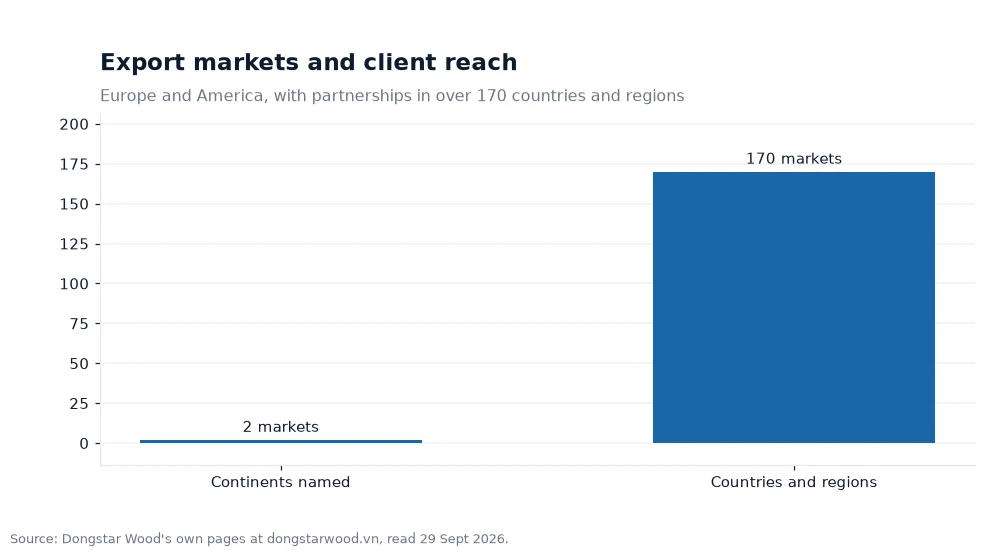
The export programme is the chain's output. The client names Europe and America as the principal markets and describes clients in over 170 countries and regions. The 170 figure is reach rather than volume — it describes how widely the panels are distributed, not how much goes to each market — and for a buyer it is evidence that the documentation and packing routines have been repeated enough times to be routine.
The capacity figures give the programme its rhythm. Monthly supply capacity exceeds 100 × 40ft across 16+ automated production lines, which works out at 100 ÷ 4 = 25 containers a week. A buyer planning a monthly order can place it inside that rhythm instead of asking the mill to create capacity for a single account.
Quality control at each stage
Quality control in this chain is staged, not final. The client names panel thickness consistency and core construction integrity as batch inspection items, and the in-house lab runs from raw materials to the export batch. The staging matters: a thickness check at the press catches a calibration drift, and the same check at the packing stage catches a shipping damage pattern.
The staged approach also produces the records a buyer needs. When testing runs from raw material to export batch, every container can be traced back to the batch it came from, and every batch can be traced back to the checks it passed. A supply chain that can answer 'which batch is in this container' is a supply chain that can answer almost any other question a buyer asks.
Documents that travel with a consignment
The final link in the chain is paperwork. Six compliance routes are listed by the manufacturer — ISO, CE, SGS, FSC, EUDR and BSCI — and the export programme adds the duty position: a No Anti-Dumping Tax position for EU and US shipments. A consignment that arrives without its documents waits at the border, which is why the document set is part of the chain rather than an afterthought.
The EUDR due-diligence statement is the newest link in the chain. A supplier claiming readiness for the deforestation regulation should be asked for the statement that links the consignment to its supply area; it travels with the CE and emission documentation. A buyer who requests the document set at the order stage receives it with the goods; a buyer who requests it after a problem receives it under pressure.
| Stage | Published fact | Role in the chain |
|---|---|---|
| Location | Yen Bai Province, northern Vietnam | Places the mill near the timber and the ports |
| Founding | 2009 | A mill that has run through several market cycles |
| Factory | 48,000 m² | Lines, packing and pressing on one site |
| Warehouse | More than 3,000 m² | Buffers batches between pressing and shipment |
| Lines | 16+ automated production lines | Sets the monthly rhythm of 100 × 40ft |
| Markets | Europe, America; over 170 countries and regions | The reach the export programme serves |
Worked example: the rhythm in containers
The published rhythm divides cleanly. The mill's monthly supply capacity exceeds 100 × 40ft; a month runs four weeks, so the throughput works out at 100 ÷ 4 = 25 containers per week. A buyer needing ten containers a month is asking for 10 ÷ 25 = 40% of one week's capacity — a substantial but schedulable share.
The factory layout confirms the arithmetic. Spreading 48,000 m² across 16 stations gives each roughly 3,000 m² — enough room for a dedicated product family to run without constant changeovers. For an order of 1,000 sheets at 1250 × 2500 mm, the area totals 1,000 × 3.125 m² = 3,125 m² of coverage, and at a site consuming 40 m² daily that lasts 3,125 ÷ 40 = 78 working days.
Frequently asked questions
Where is Dongstar Wood located?
The mill sits in Yen Bai Province, northern Vietnam, and publishes 48,000 m² of factory area alongside a warehouse of more than 3,000 m² and 16+ automated production lines on a single site.
How is a consignment packed for export?
Standard export packing uses protective wrapping, steel strapping and wooden pallets; custom packaging and labelling are available for large projects. The packing standard should be named in the order.
Which markets does the export programme cover?
Europe and America are the principal markets, with clients served in over 170 countries and regions. The stated duty position for EU and US shipments is No Anti-Dumping Tax.
From chain to order
A supply chain earns trust when each link can be checked. Vietnam Plywood as a supply story begins at the mill in Yen Bai Province, where the lines, the warehouse and the packing sit on one site. Explore the film faced plywood category to see where the formwork and construction lines fit, and the birch plywood page to understand how the furniture-grade panels move through the same chain. A buyer who reads the chain from plantation to pallet tends to write orders that match the mill's rhythm rather than fighting it.
Numerical claims here rest on data published by Dongstar Wood's own site retrieved on September 29, 2026[1].